Track brand deals without a messy spreadsheet: a seven-field pipeline
A minimal deal tracker with seven fields, a worked payment table, and an exact next-action template.
The best way to track brand deals without messy spreadsheets is one record per opportunity, a short set of stages, and one dated next action on every open deal. Use a board or creator CRM if you prefer, but test whether it can show what you owe, what the brand owes and what happens next without opening every email.
The tool is secondary to the record. A beautiful board that says only “in progress” still leaves you searching for the invoice, promised date and person who needs a reply.
What are the minimum fields in a creator deal tracker?
Start with seven grouped fields. These are an editorial starting point, not a claim that seven is an industry standard. Expand a field when the deal needs it rather than collecting empty data on every pitch.
| Field | What belongs in it | Example value |
|---|---|---|
| Brand and contact | Brand, person, email/thread reference | Example: North Studio, partnership lead |
| Stage | Where the opportunity stands | Example: negotiating |
| Deliverable and dates | Format, count, draft and live date | Example: 1 video; draft Nov 4, live Nov 8 |
| Fee and scope record | Agreed amount or clearly marked quote; link/reference to signed terms | Example: $600 quoted, not yet agreed |
| Next action, owner and date | One verb-led task, who does it, when | Example: me, send revised scope Nov 2 |
| Invoice and payment | Invoice date, due date, received amount | Example: not invoiced; $0 received |
| Terms and evidence | Contract, rights expiry, exclusivity, approvals, live-post evidence | Example: ad use not agreed; written approval needed |
Group fields for a quick view, but store separate values when you need sorting. For example, payment due should be a date, not buried in a paragraph. An email thread proves a conversation happened; it does not automatically prove a contract was agreed.
Which stages should I use?
Try pitched → replied → negotiating → agreed → delivered → paid, plus a separate closed/lost state. “Paid” means the agreed balance has cleared, not simply that you sent an invoice. Keep opportunities that end without agreement out of the paid column.
An active deal needs a next action even when the brand is the blocker. “Waiting” is a condition; “check whether the brand approved the draft on November 5” is an action. Use a calendar reminder for that date if your board cannot remind you.
The tracking model matters more than a universal deal-count threshold. If you can no longer find the next action and payment due date reliably, change the setup. There is no verified rule that every creator needs a CRM after a particular number of deals.
How do I avoid confusing promised fees with money received?
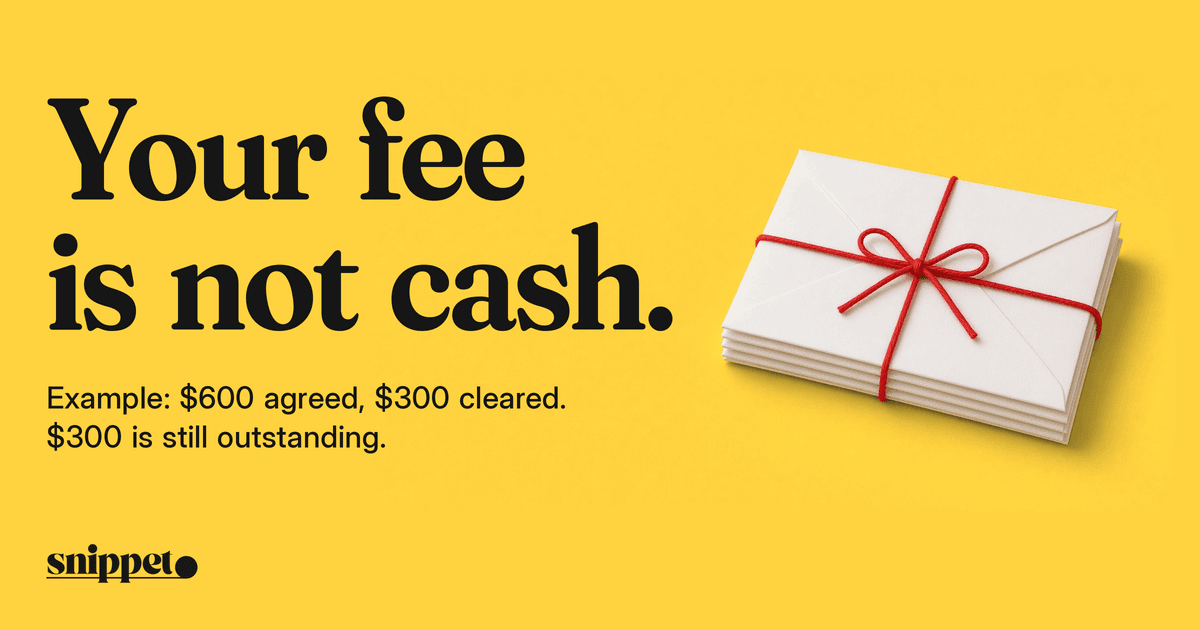
Keep three amounts distinct: agreed fee, money received and balance due. Quotes belong outside agreed revenue until accepted.
Formula: balance due = agreed fee − cleared payments. Pipeline value is potential work, not cash you can spend.
| Example deal | Agreed fee | Cleared payments | Balance due | Next action |
|---|---|---|---|---|
| A: delivered, invoice sent Nov 1 | $600 | $300 | $300 | Confirm receipt Nov 2; due Dec 1 under agreed net-30 terms |
| B: draft due Nov 4 | $900 | $0 | $900 | Send draft Nov 4; invoice timing follows agreement |
| C: quote sent, not accepted | Not agreed | $0 | Not a receivable | Ask for scope decision Nov 3 |
| Agreed-deal total, A + B only | $1,500 | $300 | $1,200 | Do not count C as money owed |
All amounts and dates in this table are Example assumptions, not creator rates or standard payment terms. Worked line: $600 agreed − $300 cleared = $300 balance. For this example, net-30 means 30 calendar days from the November 1 invoice, hence December 1; your contract must define the trigger.
What can I paste into every open deal today?
Use this fill-in record:
Next action: [one verb + concrete task]. Owner: [me / named brand contact]. Due: [date]. Waiting on: [document or decision]. Payment: [agreed fee], [cleared amount], [due date or not yet due]. Evidence: [thread or signed document reference].
Example: “Send revised one-video scope. Owner: me. Due: November 2. Waiting on: ad-use decision. Payment: not agreed; $0 cleared; no invoice due. Evidence: October 31 email thread.”
Test it on your current opportunities. If you cannot fill a blank, the next action is to get that missing decision, not to move the card forward to look busy.
What must stay visible after delivery?
Delivery does not end your obligations. Keep approval evidence, invoice status, any agreed usage or exclusivity expiry, and where the sponsored post went live. YouTube says creators must use its paid-promotion control for branded content; the platform also says applicable disclosure requirements remain the creator's and partner's responsibility. Source: YouTube branded-content guidance, opened October 31, 2026. A “disclosure checked” field is a workflow reminder, not proof of legal compliance.
Can a tool replace the record-keeping?
Choose a tool by testing a real workflow: find a reply, identify the next action, record the agreed fee and locate the terms. Do not assume a tool handles invoices, payment reconciliation or contract review because it tracks outreach.
Disclosure: Snippet is the product we build. Its current site says “Keep brand replies, rates, and deal details together.” That supports evaluating it for an outreach record, not claiming it is an accounting or contract-review system. Source: Snippet /join, checked October 31, 2026.
Which deal detail do you most often have to search for twice?
Frequently asked questions
What is the best way to track brand deals without spreadsheets?
Use one record per opportunity with a stage, dated next action, deliverable, agreed terms and payment state. A board or CRM works if those facts remain easy to find.
What should a creator brand deal tracker include?
Include brand/contact, stage, deliverable/dates, fee/scope, next action/owner/date, invoice/payment and terms/evidence. These seven grouped fields are a suggested starter model, not an industry standard.
How do I calculate the balance a brand owes me?
Subtract cleared payments from the agreed fee. A quote that has not been accepted is not an agreed receivable.
Should I mark a brand deal paid when I invoice?
No. Keep invoiced and paid separate; mark paid when the agreed balance has cleared.
Can a creator CRM handle contracts and invoices?
Only if those capabilities are actually supported and fit your workflow. Outreach tracking alone does not establish contract review, invoicing or accounting support.
Aayush Upadhyay
Co-founder, Snippet
Building Snippet, the AI talent agency that helps content creators land brand deals without agencies. Previously scaled creator partnerships at multiple startups. Obsessed with using AI to democratize talent management for the 32 million mid-tier creators who deserve better representation.
Related Articles
First sponsor offer tied to views? Check the payment cliff before saying yes
A worked cliff-versus-base payout table, five terms to define, and a first-sponsor counter script with Example figures.
Brand offered less than you quoted? Counter without giving away extra work
Two concrete scope options, Example quote arithmetic, and word-for-word replies for gifting, broad usage and exclusivity.
Pitch bounced or ignored? Find the right contact before sending again
A bounce-versus-silence decision table, Gmail limits with context, and a routing script for creator brand pitches.
What Is an AI Talent Manager? How AI Is Replacing Creator Agencies
AI talent managers automate brand deals for creators — from discovery to outreach to follow-up. Here's how they work, what they cost, and whether they're worth it.
Frequently Asked Questions
What is the best way to track brand deals without spreadsheets?
Use one record per opportunity with a stage, dated next action, deliverable, agreed terms and payment state. A board or CRM works if those facts remain easy to find.
What should a creator brand deal tracker include?
Include brand/contact, stage, deliverable/dates, fee/scope, next action/owner/date, invoice/payment and terms/evidence. These seven grouped fields are a suggested starter model, not an industry standard.
How do I calculate the balance a brand owes me?
Subtract cleared payments from the agreed fee. A quote that has not been accepted is not an agreed receivable.
Should I mark a brand deal paid when I invoice?
No. Keep invoiced and paid separate; mark paid when the agreed balance has cleared.
Can a creator CRM handle contracts and invoices?
Only if those capabilities are actually supported and fit your workflow. Outreach tracking alone does not establish contract review, invoicing or accounting support.