First sponsor offer tied to views? Check the payment cliff before saying yes
A worked cliff-versus-base payout table, five terms to define, and a first-sponsor counter script with Example figures.
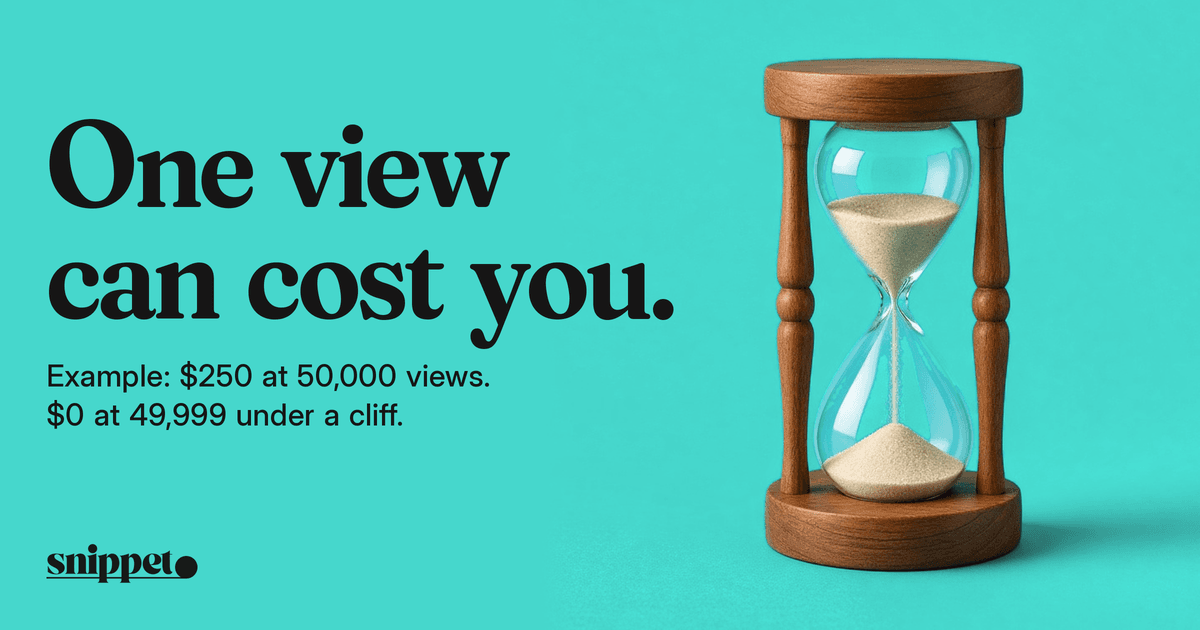
A first sponsorship that pays only after a view target is met can leave you doing the entire job for $0; evaluate the below-target payment before deciding whether to accept. Ask for a guaranteed base or consciously accept the downside, then define the view counter, measurement deadline, payment due date and any required redo in writing.
A small subscriber count does not answer whether those terms are acceptable. Your work, likely comparable-video outcomes and ability to absorb a miss matter more than the excitement of a first sponsor email. This guide evaluates conditional payment, not whether a particular sender is legitimate or what a universal sponsorship rate should be.
What happens if I miss by one view?
Use the written payment rule, not the brand's headline amount. For the Example below, the cliff pays $250 only at at least 50,000 views measured 30 days after posting. Otherwise it pays $0. The alternative proposes $150 guaranteed plus $100 at the same target. These are invented teaching terms, not a quoted live offer or recommended rates.
| Example outcome at day 30 | $250 cliff, no guaranteed base | $150 base + $100 target bonus |
|---|---|---|
| 10,000 views | $0 | $150 |
| 49,999 views | $0 | $150 |
| 50,000 views | $250 | $250 |
| 150,000 views | $250 | $250 |
This example has no additional tiers above 50,000. Three times the target does not increase pay unless the contract says it does. A base moves part of the downside away from the creator; it does not guarantee that the total fee covers your time or costs.
How do I calculate the downside for my time?
Use a second Example: 10 hours of work and $40 of direct costs, before tax. Calculate (payment − direct costs) ÷ hours.
At 49,999 views, the cliff gives (0 − 40) ÷ 10 = −$4/hour after those direct costs. Under the example base, (150 − 40) ÷ 10 = $11/hour. At the target, either gives (250 − 40) ÷ 10 = $21/hour under the same assumptions. These are exercise results, not market pay estimates, and exclude tax and other overhead.
If your decision depends on the chance of hitting the target, make that assumption explicit. Example only: assume a 40% chance of the target, with no higher bonus tier. Expected cliff payment = 0.40 × $250 + 0.60 × $0 = $100. Expected base-plus-bonus payment = $150 + 0.40 × $100 = $190. Expected value averages a hypothetical repeated situation; it is not a forecast or a guarantee of what this video pays. Do not infer 40% from two successful videos.
Which five blanks should I fill before accepting?
| Term | Exact question for the brand |
|---|---|
| Payment below target | What amount is guaranteed if the target is missed? |
| View definition | Which platform counter, video, territory and organic/paid views count? |
| Measurement deadline | On what date, at what time and timezone is the final count taken? |
| Payment due | When is the guaranteed amount and any bonus due, and what triggers invoicing? |
| Failure, redo and cancellation | What happens if reporting fails, the target is missed, or the campaign is canceled? Are any redos required and paid? |
“Net-30” alone is incomplete if the invoice trigger is unknown. Thirty days after posting and thirty days after a later measurement date can be different payment dates. Ask for the actual trigger and a checkable deadline.
What should I compare the target with?
Look at recent videos of similar topic, length and format, measured after the same elapsed time as the proposed target. Include weak performers. A lifetime view total is not comparable to a day-30 target, and your best outlier is not a minimum result you can promise.
If you lack enough comparable videos, mark the probability unknown. That uncertainty is a reason to examine the guaranteed payment carefully, not to invent a confident success rate.
What counter can I send for a base plus bonus?
Use this fill-in version:
Thanks for the offer. Can we agree [base amount] guaranteed for [deliverable], plus [bonus] at [target views]? Please confirm [counter and counted-view rules], [measurement date/timezone], payment due [date/trigger], and whether any redo is required and separately paid.
A shorter Example proposal:
Can we agree $150 guaranteed plus $100 at 50,000 YouTube Studio views on day 30, payable by day 45, with no unpaid redo? Please confirm how paid views are treated and the exact measurement date and timezone.
The brand can counter or decline. If the guaranteed amount still does not work for your costs, the existence of a base is not itself a reason to accept. Also evaluate the requested usage rights separately; this comparison does not assume the brand gets unlimited ad use.
Does a first deal need different disclosure?
Fee size and subscriber count do not replace the platform's branded-content process. YouTube says creators featuring sponsorships or other commercial relationships must select its paid-promotion control, and says creators and partners remain responsible for applicable requirements. Source: YouTube branded-content guidance, opened October 31, 2026. Keep that step in your delivery checklist without treating it as a full compliance assessment.
What condition would you change before accepting your first offer?
Frequently asked questions
Should I accept a sponsor that only pays after a view target?
Check the guaranteed payment below target and whether you can absorb that downside. Define the counted views, deadline, payment timing and any redo before deciding; a first offer is not automatically worth accepting.
What happens if my sponsored video misses the target by one view?
It depends on the written payment rule. Under the article’s Example cliff, 49,999 views pays $0 while 50,000 pays $250; those are teaching assumptions, not universal terms.
Can I ask for a guaranteed fee plus a view bonus?
Yes, you can propose it as a negotiation option. The brand may decline, and the base still needs to make sense for your costs and requested rights.
Should I accept a sponsorship with 500 subscribers?
Subscriber count alone does not determine whether the offer works. Review audience fit, required work, conditional payment, rights and your ability to meet the actual brief.
Which views should count toward a sponsorship target?
Agree the platform counter, eligible video, organic or paid-view treatment, measurement date/timezone and reporting-failure rule. Use the same measurement window when comparing your own past videos.
Aayush Upadhyay
Co-founder, Snippet
Building Snippet, the AI talent agency that helps content creators land brand deals without agencies. Previously scaled creator partnerships at multiple startups. Obsessed with using AI to democratize talent management for the 32 million mid-tier creators who deserve better representation.
Related Articles
Brand offered less than you quoted? Counter without giving away extra work
Two concrete scope options, Example quote arithmetic, and word-for-word replies for gifting, broad usage and exclusivity.
Pitch bounced or ignored? Find the right contact before sending again
A bounce-versus-silence decision table, Gmail limits with context, and a routing script for creator brand pitches.
What Is an AI Talent Manager? How AI Is Replacing Creator Agencies
AI talent managers automate brand deals for creators — from discovery to outreach to follow-up. Here's how they work, what they cost, and whether they're worth it.
AI Talent Managers for Creator Brand Deals: Snippet, Ghost and Bento
Compare Snippet, Ghost and Bento for brand-deal pitching, follow-ups and tracking. Public pricing, small-creator fit and when each tool makes sense.
Frequently Asked Questions
Should I accept a sponsor that only pays after a view target?
Check the guaranteed payment below target and whether you can absorb that downside. Define the counted views, deadline, payment timing and any redo before deciding; a first offer is not automatically worth accepting.
What happens if my sponsored video misses the target by one view?
It depends on the written payment rule. Under the article’s Example cliff, 49,999 views pays $0 while 50,000 pays $250; those are teaching assumptions, not universal terms.
Can I ask for a guaranteed fee plus a view bonus?
Yes, you can propose it as a negotiation option. The brand may decline, and the base still needs to make sense for your costs and requested rights.
Should I accept a sponsorship with 500 subscribers?
Subscriber count alone does not determine whether the offer works. Review audience fit, required work, conditional payment, rights and your ability to meet the actual brief.
Which views should count toward a sponsorship target?
Agree the platform counter, eligible video, organic or paid-view treatment, measurement date/timezone and reporting-failure rule. Use the same measurement window when comparing your own past videos.