How to Get Brand Deals on Instagram in 2026
Step-by-step guide to landing Instagram brand deals — from optimizing your profile and building a media kit to pitching brands and negotiating rates. Data-backed strategies for creators at every level.
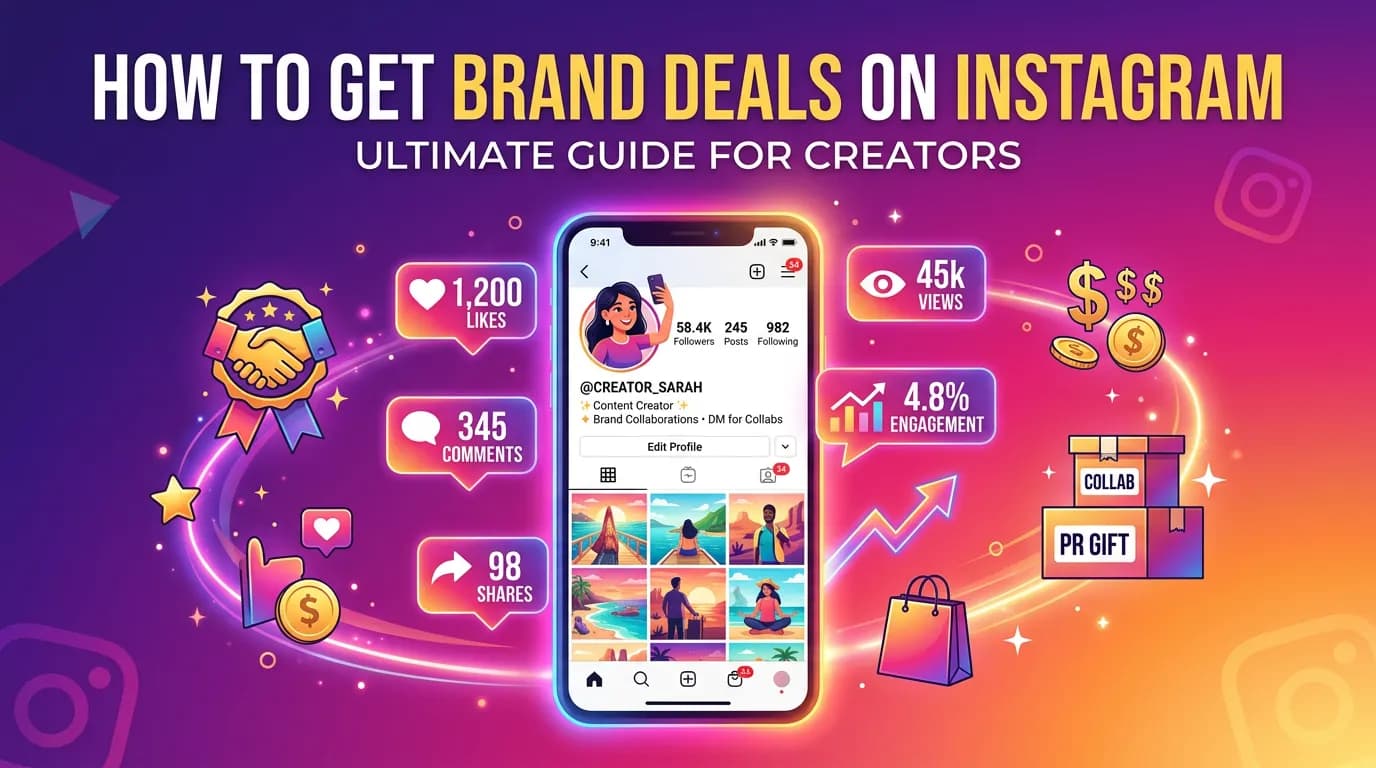
To get brand deals on Instagram, optimize your profile as a Creator or Business account with clear niche positioning, build a portfolio of high-engagement Reels and carousels, then proactively pitch brands with personalized emails that reference their recent campaigns and propose specific content ideas. Instagram remains the highest-paying platform per post for creators under 500K followers, and brands are spending more on Instagram creator partnerships in 2026 than any prior year.
Evidence supporting this includes:
- Instagram accounts for 30.7% of global influencer marketing spend, more than any other single platform (Influencer Marketing Hub 2025 State of Influencer Marketing Report)
- Instagram Reels generate 67% more engagement than standard feed posts (HypeAuditor 2025 Instagram Engagement Report)
- 75% of brands increased their creator marketing budgets in 2025, with Instagram receiving the largest share of new spend (Goldman Sachs Creator Economy Report)
- Creators who pitch brands directly earn 25-40% higher rates on average than those who rely solely on inbound marketplace offers (CreatorIQ Campaign Benchmark Data)
This guide covers everything from profile optimization and content strategy to finding brands, setting Instagram-specific rates, and negotiating deals that protect your time and content.
Why Instagram Is the Top Platform for Brand Deals in 2026
Instagram is where brand deal money concentrates. According to Influencer Marketing Hub's 2025 report, Instagram captures 30.7% of global influencer marketing spend — ahead of TikTok at 23.4% and YouTube at 21.2%. For creators in the 10K to 500K follower range, Instagram consistently delivers the highest per-post rates relative to production effort.
Three factors drive this. First, Instagram's ad infrastructure is mature. Brands can boost creator content as paid partnership ads, run whitelisted campaigns from creator handles, and track conversions end-to-end through Meta's Ads Manager. This makes it easier for brands to justify spend.
Second, Instagram's format diversity gives brands flexibility. A single partnership can include a Reel for reach, Stories for direct-response, and a carousel for detailed product education — all within one platform. Brands value this because it reduces the number of creator relationships they need to manage.
Third, Instagram's audience demographics skew toward the 25-to-44 age bracket that most consumer brands target. According to Statista's 2025 Instagram demographics data, over 50% of Instagram's active user base falls in this range, making it the default platform for brand partnerships in fashion, beauty, fitness, food, travel, and lifestyle niches.
How to Optimize Your Instagram Profile for Brands
Before you pitch anyone, your profile needs to look like a professional partnership opportunity. Brands evaluate your Instagram page within seconds, and small details signal whether you are worth a conversation.
Switch to a Creator or Business account if you have not already. This gives you access to Instagram Insights — audience demographics, reach, and engagement data — which you will need for every pitch and media kit. Creator accounts also make you eligible for the Instagram Creator Marketplace.
Your bio should state your niche, your audience, and a hint at what a brand gets by working with you. Skip vague descriptors like "content creator" or "lifestyle blogger." Instead, be specific: "Helping 80K home cooks find weeknight dinner ideas" or "Fitness content for women 25-35 who hate the gym." Brands want to immediately understand who your audience is.
Your grid is your portfolio. The last 9 to 12 posts should tell a cohesive visual story with consistent quality. If your feed is a mix of random personal photos and polished content, brands will question your professionalism. This does not mean every post needs to be a production — it means the overall impression should be intentional and on-brand.
Build a media kit that includes your Instagram-specific metrics: follower count, average Reel views, engagement rate, audience age and gender split, top-performing content examples, and past brand collaboration results. Keep it to one page.
Instagram Content Types That Attract Brand Deals
Not all Instagram content carries equal weight with brands. Understanding what brands actually want to buy in 2026 lets you tailor your content strategy accordingly.
Reels are the highest-demand format. Instagram's algorithm continues to prioritize short-form video, and Reels deliver 67% more engagement than static feed posts according to HypeAuditor. For brands, Reels offer the best reach-to-cost ratio and can be repurposed as paid ads through Meta's whitelisting tools. If you are not posting Reels consistently, you are invisible to most brand budgets.
Carousel posts are the workhorse of product-focused partnerships. They allow creators to walk through features, comparisons, or tutorials across multiple slides, and they generate the highest save rates of any Instagram format. Brands in education, SaaS, skincare, and food especially value carousels because they drive informed purchase decisions.
Stories remain essential for direct-response campaigns. Swipe-up links (available to all accounts via link stickers), polls, and question boxes give brands measurable click-through data. Stories are often bundled with Reels or feed posts rather than sold standalone, but they add significant value to any package.
Collaborative posts using Instagram's paid partnership label are increasingly required by brands for FTC compliance. Collab posts appear on both the creator's and the brand's feed, doubling organic reach. Brands that run creator content as paid ads through Meta Ads Manager almost always require the paid partnership tag.
The strongest brand deal packages combine multiple formats. A Reel for reach plus three Stories for engagement plus a carousel for product detail commands a higher total rate than any single format alone.
How to Find Brands on Instagram
Finding the right brands to pitch is the step most creators skip or do poorly. Random DMs to brand accounts convert at near-zero rates. Systematic research converts at 5 to 15%.
Instagram Creator Marketplace is Meta's built-in matchmaking tool. Once you activate it in your professional dashboard, brands can discover you based on your niche, audience demographics, and engagement metrics. It is passive — brands come to you — but it works best as a supplement to active outreach, not a replacement.
Instagram Ad Library is an underused research tool. Visit Meta's Ad Library, filter by your niche keywords, and identify brands actively running Instagram ads. If a brand is spending money on Instagram ads, they have a marketing budget and they are already investing in the platform. These are warm prospects.
Competitor and peer analysis is the fastest way to build a prospect list. Look at creators in your niche with similar or slightly larger followings. Which brands are they tagging in paid partnerships? Those brands are actively working with creators at your level and are likely open to more partnerships.
AI-powered brand discovery tools like Snippet automate this entire process. Instead of manually scrolling through Ad Library and competitor profiles, Snippet analyzes your content, audience, and niche to find brands that are the right fit — then generates personalized outreach for each one. For creators who find the research phase overwhelming, this is where AI saves the most time.
Creator networks and communities — Facebook groups, Discord servers, and platforms like Hashtag Paid, AspireIQ, and Grin — are additional sources. These tend to surface smaller deals and are more competitive, but they are worth monitoring alongside your direct outreach pipeline.
Instagram Brand Deal Rates by Follower Count
Pricing Instagram content correctly is the difference between sustainable income and chronic underpricing. These rate ranges are based on Influencer Marketing Hub and HypeAuditor data for 2025-2026 and reflect standard sponsored content rates in the US market.
| Follower Tier | Reel | Carousel Post | Story (set of 3) | Bundle (Reel + Stories + Post) |
|---|---|---|---|---|
| 1K - 10K (Nano) | $50 - $250 | $50 - $200 | $25 - $100 | $100 - $500 |
| 10K - 50K (Micro) | $200 - $1,000 | $150 - $600 | $100 - $300 | $400 - $1,500 |
| 50K - 100K | $600 - $2,000 | $400 - $1,200 | $200 - $600 | $1,000 - $3,000 |
| 100K - 500K | $1,500 - $5,000 | $1,000 - $3,500 | $500 - $1,500 | $2,500 - $8,000 |
| 500K - 1M (Macro) | $5,000 - $15,000 | $3,000 - $8,000 | $1,500 - $4,000 | $8,000 - $20,000 |
These are starting points, not ceilings. Engagement rate, niche, audience quality, and production value all shift rates significantly. A 30K-follower fitness creator with a 6% engagement rate and high-quality Reels can command rates closer to the 50K-100K tier.
Check your Instagram engagement rate to understand where you fall relative to benchmarks. Engagement rate is the single most important metric brands evaluate after niche relevance.
For a deeper breakdown of pricing across all platforms and content types, see the full guide on how much to charge for brand deals.
Let Snippet handle brand outreach for you
AI-powered brand discovery, personalized pitches from your Gmail, automated follow-ups, and reply management. Try free for 7 days.
Close deals for meHow to Pitch Brands for Instagram Deals
The pitch email is where most creators lose deals before they start. According to CreatorIQ's campaign data, personalized pitches convert at 3 to 5 times the rate of templated outreach. Every brand can tell the difference.
A strong Instagram-specific pitch has five components. Start with a subject line that is specific and relevant — "Instagram Reel idea for [Brand]'s spring campaign" outperforms "Collaboration opportunity" every time. Open with proof that you know the brand by referencing a recent campaign, product launch, or Instagram ad you have seen.
Next, connect your audience to their customer. "My audience is 78% women aged 25-34 in the US who engage heavily with skincare content" is a concrete fit statement. Follow with a specific content idea — not "I would love to collaborate" but "I would create a 30-second Reel showing my morning routine featuring [Product], plus 3 Stories with a swipe-up link to your site."
Close with a clear call to action and keep the entire email under 150 words. Attach or link your media kit. Do not include rates in the initial pitch — let the brand express interest first, then negotiate.
For ready-to-use templates and more pitch examples, see the full brand outreach email template guide.
If writing personalized pitches for dozens of brands feels overwhelming, AI tools like Snippet generate tailored outreach emails based on your profile and each brand's activity — maintaining your voice while handling the research and personalization at scale.
Negotiating Instagram Brand Deals
Once a brand responds with interest, the negotiation determines whether you get paid fairly or leave money on the table. Creators who negotiate earn 25 to 40% more per deal than those who accept the first offer, according to CreatorIQ benchmark data.
Start with CPM-based pricing. Take your average Reel views over the last 30 days, divide by 1,000, and multiply by your target CPM. Instagram CPMs for sponsored Reels typically range from $20 to $80, depending on niche and audience quality. A creator averaging 40,000 Reel views at a $40 CPM should quote $1,600 as a baseline. Always quote 20 to 30% above your target — brands expect to negotiate down.
Charge separately for usage rights. If the brand wants to run your content as a paid ad through their Meta Ads Manager account, that is a separate fee. Industry standard is 25 to 100% of the base rate per month of usage, depending on the scope of distribution. Never include usage rights in your base rate.
Whitelisting commands a premium. Whitelisting means the brand runs ads from your Instagram handle, making the ad appear to come from you. This is more valuable than standard usage rights because it leverages your identity and credibility. Charge 30 to 50% on top of usage rights fees for whitelisting access.
Exclusivity narrows your earning potential. If a brand asks you to avoid working with competitors during or after the campaign, that exclusivity costs them 20 to 50% extra. Define "competitor" narrowly in the contract — "direct competitor in the protein powder category" rather than "any health and fitness brand."
Review every contract for red flags before signing. Perpetual usage rights, broad exclusivity windows, and payment-on-publication terms are the most common issues. For a detailed breakdown, see the guide on how much to charge for brand deals and the contract red flags guide.
Common Mistakes to Avoid
Buying followers or engagement. Brands and their agencies use tools like HypeAuditor and Social Blade to detect fake engagement. Getting caught does not just kill one deal — it blacklists you from future opportunities with that brand and their agency network.
Accepting product-only deals when you have leverage. If your engagement rate is above 3% and you have more than 5,000 followers, you have enough leverage to command paid partnerships. Product-only deals are acceptable when you are building your portfolio in the first few months, but they should not be your norm beyond that.
Posting without the paid partnership label. FTC and platform compliance require disclosure. Using Instagram's built-in paid partnership tool protects both you and the brand legally. Brands that ask you to skip disclosure are not worth working with.
Neglecting Stories and DMs during a campaign. Brands track not just the post metrics but how you engage with your audience around the sponsored content. Responding to comments, answering DM questions about the product, and adding Stories that complement the main post all increase campaign performance and your chance of repeat deals.
Pricing based on follower count instead of engagement. A 20K-follower account with a 7% engagement rate delivers more value than a 100K-follower account with 0.8% engagement. Always price based on average views and engagement rate, not the follower number on your profile. Use a CPM-based formula and your actual performance data.
Going dark after posting. The 48 hours after your sponsored content goes live are critical. Send the brand a performance snapshot — views, engagement rate, saves, link clicks, and standout comments. This turns a one-time transaction into a relationship, and creators who share results proactively are 3 to 4 times more likely to secure repeat partnerships.
Aayush Upadhyay
Co-founder, Snippet
Building Snippet, the AI talent agency that helps content creators land brand deals without agencies. Previously scaled creator partnerships at multiple startups. Obsessed with using AI to democratize talent management for the 32 million mid-tier creators who deserve better representation.
Related Articles
How to Get Brand Deals in 2026: Step-by-Step Guide for Creators
Land your first (or next) brand deal with this step-by-step playbook. Covers finding brands, writing pitches that get replies, setting rates, negotiating contracts, and scaling to consistent monthly deals.
How Much to Charge for Brand Deals in 2026 (Rate Card by Platform)
Exact brand deal rates for YouTube, Instagram, TikTok & Twitter/X — broken down by follower count, niche, and content type. Includes CPM formula, usage rights pricing, and negotiation scripts.
I Reviewed 100+ Creator Media Kits — Here's the One-Page Structure Brands Actually Want to See
After reviewing 100+ media kits from the brand side, most are either 15-page PDFs or SocialBlade screenshots. Here's the exact one-page structure that gets responses, including what to cut.
The Brand Outreach Email That Got a 34% Response Rate — Template Inside
After sending thousands of brand emails on behalf of creators, here's the 3-P email structure that consistently gets responses, plus the timing, subject lines, and follow-up cadence that close deals.
Frequently Asked Questions
How many Instagram followers do you need for brand deals?
You can get brand deals with as few as 1,000 followers. Brands increasingly partner with nano and micro-influencers (1K-50K) because they deliver 3-8% engagement rates compared to 1-2% for macro-influencers. Engagement rate matters more than follower count.
How much do Instagram brand deals pay?
Instagram brand deal rates vary by follower count and content type. Nano-influencers (1K-10K) earn $50-$500 per post, micro-influencers (10K-50K) earn $200-$2,500, mid-tier (50K-500K) earn $1,000-$10,000, and macro-influencers (500K-1M) earn $5,000-$20,000+. Reels typically command 20-40% more than static posts.
What types of Instagram content do brands want?
Brands most commonly request Instagram Reels (highest demand in 2026), carousel posts with product features, Stories with swipe-up links, and collaborative posts using Instagram's paid partnership label. Multi-format packages combining Reels + Stories + a feed post command the highest total deal value.
How do I find brands to work with on Instagram?
Search the Instagram Creator Marketplace, research brands advertising in your niche through Instagram's Ad Library, look at what brands your peers are partnering with, use AI tools like Snippet for automated brand discovery, and join creator networks and Facebook groups where opportunities are shared.
Should I use Instagram Creator Marketplace or pitch brands directly?
Both. The Creator Marketplace lets brands find you, but proactive outreach generates 3-5x more deals for most creators. Direct pitching gives you control over which brands you work with and typically results in higher rates than marketplace-sourced deals.
Try Snippet free for 7 days
AI talent agency for content creators.$50/month, flat monthly price.
Close deals for me